AUG 26 2026 · WRITTEN AT HOME · PERSONAL
The Journey Within. How to Master Discernment
The older I get, the less interested I am in what people call themselves (pastor, teacher, healer, expert) and the more interested I am in what remains inside me after they leave. Some people awaken something: curiosity, peace, personal responsibility, a desire to love more deeply. Others leave behind fear, guilt, urgency, or the feeling that I must surrender my own knowing to follow theirs. I’ve come to believe that this aftermath is one of our clearest forms of discernment. Real guidance brings us closer to ourselves and to God; counterfeit guidance recruits us into someone else’s storm.
I’m sitting on my bed, the glow of my laptop lighting the sheets, emails half-written and waiting for me. But my attention keeps drifting toward this question of how people make us feel.
Some people leave me softer, as though my shoulders drop simply from being near them. Around others, something inside me tenses or steps backward, even when they never raise their voice.
I’ve started paying attention to that. It doesn’t lie.
On work calls. In crowded rooms. Around spiritual teachers. I’m no longer impressed by how someone introduces themselves. I’m interested in the echo they leave in my chest.
My mind returns to a conversation with someone I admire, Master Lin of Spring Forest Qigong. There is no performance with him. He once spoke to me about two ways of caring for ourselves.
There is the passive: resting, allowing and receiving.
Then there is the proactive: choosing, practicing and sitting down to breathe when no one is watching.
Being proactive, he explained, is how we refine ourselves spiritually. It’s how we don’t get left behind.
He also spoke about breath. Here on Earth, it is what keeps us alive: in and out, constant and fragile. But on other planets, he said, there may be beings that don’t breathe as we do. Without an atmosphere like ours, they may take what they need directly from the sun. They live from light.
That thought stayed with me.
What am I taking in from the world around me? What kind of air am I breathing from people, rooms, institutions and all these so-called teachers? Do I leave feeling full, or do I leave feeling emptied?
This is the kind of knowledge that makes me happy.
Being “awake” doesn’t make life easier. It isn’t floating on a cloud or speaking in perfect wisdom. It’s more like seeing clearly for the first time and realizing how much of life has been built upon noise, distraction and inherited beliefs that were never questioned.
Once you see it, you can’t unsee it, and that makes you responsible.
When something goes wrong, I don’t collapse into the old story of, “Why does everything happen to me?” Instead, I try to catch myself and ask:
What is this showing me?
Where do I need to adjust?
What good could come from this, even if I can’t see it yet?
That’s what being awake means to me. Not perfection. Not constant peace. Just a quiet kind of strength: the willingness to choose awareness over illusion, even on the days when going back to sleep would be easier.
Discernment matters more now than it ever has in my lifetime. Anyone can step behind a microphone, call it a pulpit and gather an audience. A uniform or a preacher’s voice can be worn like a costume. The agenda behind it is rarely loud. More often, it is polished, patriotic and wrapped in scripture.
But their words don’t make your heart softer.
Real devotion makes you want to love. Counterfeit devotion makes you afraid not to.
I’ve heard modern pastors who sound less like shepherds and more like strategists: politics woven into prayers and sermons becoming instructions about whom to fear, whom to hate and whom to vote for.
Faith isn’t the problem. The problem begins when faith becomes a tool to command, recruit, shame or control.
Love doesn’t need soldiers. It needs witnesses.
I worked at one of the largest churches in Virginia. Behind the scenes, I saw people with titles but without tenderness, people directing like officers instead of caring for others like shepherds. The rooms were warm in lighting but cold in spirit.
The people themselves were often incredibly kind. Yet many seemed disconnected from their own knowing while being mentally and financially consumed by the system around them.
That experience taught me something I will always repeat: You do not need a middleman to speak to God.
Anyone can become a pastor. A title cannot guarantee tenderness, wisdom or truth. I’ve learned instead to notice the mismatch between someone’s language and their energy.
If their guidance makes you feel freer, more loving and more peaceful, there may be truth in it. If it makes you feel frightened, diminished, guilty or blindly obedient, that isn’t God.
It’s choreography.
Maybe that’s why I no longer expect all my answers to come from textbooks. My questions don’t fit neatly into bullet points. I want to talk about beings that might live from light, the darkness between stars, sacred geometry and the quiet ways symbols shape our world.
I want to understand how language and images can be used not to teach us, but to corral us, to domesticate our minds until we forget how to ask real questions.
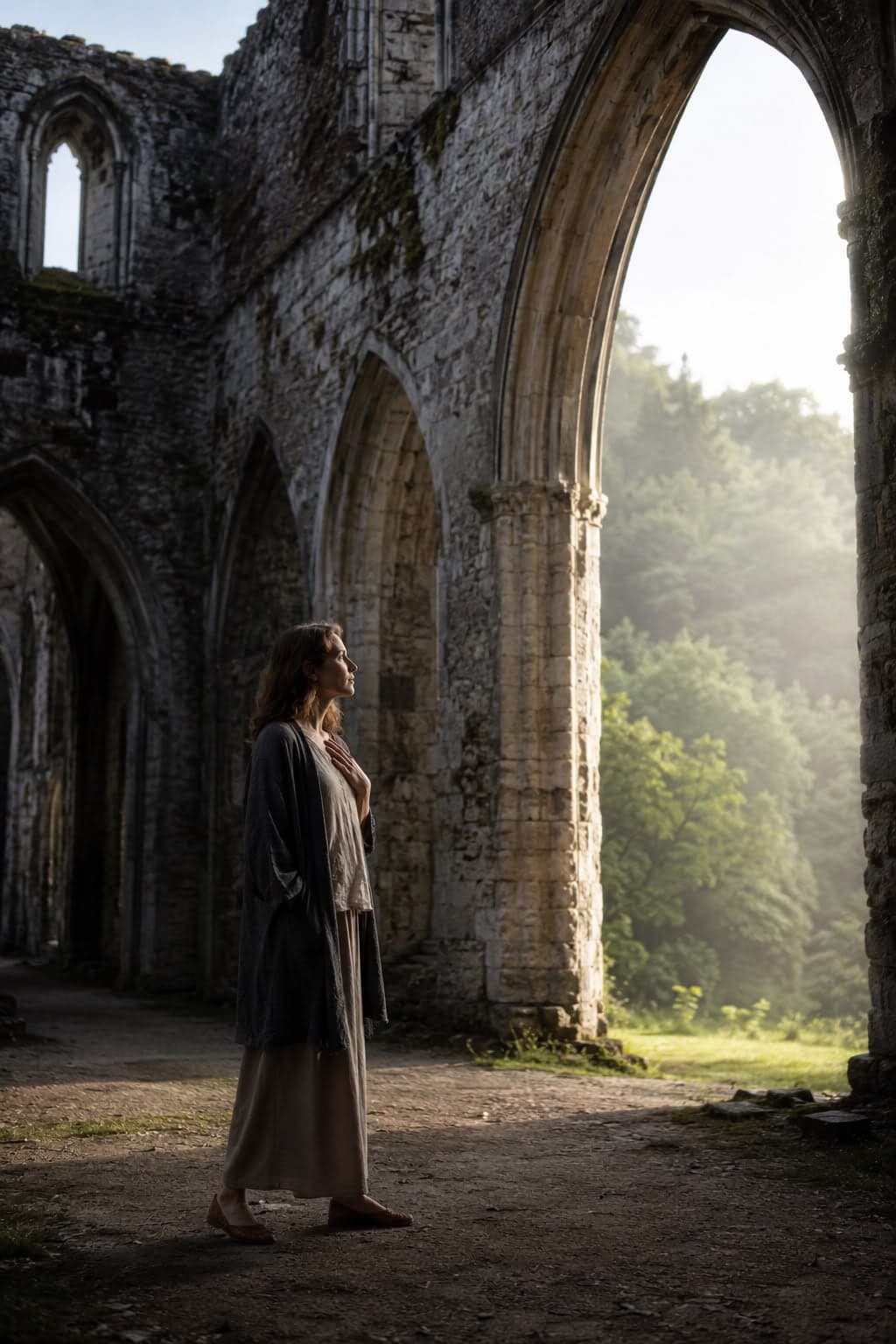
This summer, I drove through the English countryside toward Fountains Abbey. Soft green fields stretched along both sides of the road, divided by stone walls and morning mist.
The ruins stood in silence: ancient arches, broken walls and sky pouring through what had once been a roof. The moment I saw them, my walking slowed. My eyes nearly filled with tears, not from sadness, but from a deep and inexplicable recognition.
It felt like remembering a place I had never visited.
Someone once told me that I have an ancient soul and a history connected to Tibet: monks, old prayer halls and quiet discipline carried through lifetimes. Maybe that’s why the abbey affected me so deeply. Maybe it’s why Master Lin feels familiar, like someone I knew in another time.
Maybe some things don’t need to be proven before they can be felt.
And while all of this may sound mystical, I’m still very human. I don’t move my body enough. I plan to wake up at 6:30 and often get up at 7:30. I eat what’s convenient instead of what truly nourishes me. I have notebooks filled with ideas I haven’t acted upon.
People may see me online and imagine I’m always productive and disciplined. I’m not. I procrastinate. I become overwhelmed. I get stuck.
But I also know that when I truly focus and align, things move. They always do.
So this is the compass I’m learning to follow:
Choose invitations over ultimatums. Real teachers open windows, not cages.
Measure progress in months, not minutes. Eight months of focus can outrun fifteen years of wishing.
Check the aftermath. Warmth, peace, freedom and non-judgment mean continue. Control, dread, guilt and urgency mean step back.
Recognition over recruitment.
Do I recognize myself more clearly after being with you?
Or do I feel as though I’m being drafted into your storm?